This works for just about every root - although we aren't partial to carrot tops - beets, turnips, celeriac, rutabagas. I pick the greens and then usually there is at least one more crop from the energy from the piece of root.
Wednesday, December 10, 2014
Greens from Root Tops
This is a great beginning gardener or "kid project." After you rinse off a root, cut the top (stem end) at the shoulders, place in a low dish of water in a sunny window and after a few days, the green tops start.
This works for just about every root - although we aren't partial to carrot tops - beets, turnips, celeriac, rutabagas. I pick the greens and then usually there is at least one more crop from the energy from the piece of root.
Wednesday, December 3, 2014
Harvest Newsletter
Greetings from the Garden! This week's CSA box has greens for salad or braising, leeks, garlic,squash or pumpkin, potatoes, black radish, rutabaga, turnips, cabbage, shallots. winter tomatoes, and carrots.Field Notes. Unseasonably cold weather signals that the season for outdoor greens is coming to a close. We grow micro greens in winter and have green storage cabbage, too. Ken has been making cultured vegetables: sauerkraut, gingered carrots, fall roots, and beets. These vegetables plus salt create probiotics and preserve the vitamin C that would be lost with heat in cooking or canning.
He has been planting greens for next month as well. With the short days plants start and grow slowly. Organic grower Eliot Coleman calls this the Persephone season after the Greek goddess. She was abducted by Hades of the Underworld and so her mother Demeter, goddess of the harvest sets soil and crops to rest and sleep until her return in spring. Coleman contends that little has enough light to grow, but some plants can be stored for winter use.
I have finished sorting seeds, and doing an inventory of what we have and soon will be ordering for next season. I have received a few responses to my request for preferences. Those lists help us prioritize what to grow the next season. We really appreciate the feedback. Thank you.
From the Kitchen. This year presented some real challenges. We got late rain and the winter squash is not keeping as well as it usually does. Ken has cooked, pureed and packed in ziploc bags for the freezer. We have had squash pie a couple times and squash soup. We both love squash and its beta carotene is an added health benefit
Thank goodness for leeks. They are sweet, smooth and can be used in any onion recipe. I like to saute onions and add chopped braising greens or cabbage so it wilts and then add cream or vinegar or a dressing. Years ago someone shared a recipe with sauteed onion or leek, wilted greens tossed with pasta and topped with a spicy dressing like Caesar or Italian garlic dressing. They also added olives or nuts.
Tuesday, November 25, 2014
Sauerkraut Day
Today we made sauerkraut. Or maybe I should say Ken made sauerkraut with my help. He brought up the storage cabbage - four large recycle tubs.
I then pulled off any wilted leaves.
Then it was rinse and drain.
I moved them over to where Ken was shredding.
He has had this kraut cutter for more decades than I have known him!
We save the cabbage cores in a cool place for the next batch of soup stock. This season it will be goose bones after we butcher them - once we get another warm spell and some pork bones from the locker
Then Ken weighs the shredded cabbage and adds salt...
...and juniper berries.
Then it goes down to the crock where Ken pushes it until the liquid rises above the cabbage, and then he places a weight over the kraut and covers it. Fermentation time varies with the temperature.
The last batch just came out of the crock Sunday and is now in jars in the cooler.
We took a field tip to get organic ginger root for the next batch of fermented vegetables - gingered carrots.
Thursday, November 20, 2014
Experience Clay
EXPERIENCE CLAY –
Four Saturdays in
January 2015. 9–11:30 a.m.
Ken Keppers, studio
potter, teaches the basics –
Pinch, coil, and slab
construction. Wheels available.
GREAT GIFT IDEA
Sign up for one or
more classes at $20 rate per class
Or all four classes $65
Ken Keppers
Turtle Lake, WI
(715) 986 – 4322
kepperspottery.com
Tuesday, November 18, 2014
Harvest Newsletter
Greetings from the Garden! This week's CSA box has greens, potatoes, winter tomatoes, carrots, the last fall dug parsnips, rutabaga, black and daikon radishes, pie pumpkins, leeks, garlic, and herbs - parsley and maybe dill.Field Notes Ken got his straw and has begun mulching - the garlic is done. Next he will be doing strawberries. He mulches after it has gotten cold and wants to avoid the perennials starting too early if we get early warm weather. The goal is for them to start once we know they won't have frost damage - this occurred a couple years back when the weather in March was in the 80's. Many plants thought spring had arrived and then suffered later frost!
We covered plants inside the mobile tunnel with fiber for a double layer - we will see how they fare. We were both really happy to see snow before the cold. It was amazing how insulating the snow was! It sealed up all the small cracks along the ground and inside the mobile was warmer and damp - even when the sun was not shining directly on the greenhouse!
This was the week we were featured on Around the Farm Table. If you missed it you can watch teh Skijoring with Carlos episode and see us http://video.wpt.org/program/around-farm-table
Next warm weather Ken will be wrapping up work on that north coop so we can shift chickens to larger space. These are next year's layers, and then he will move a hen and chicks from a hoopette to the smaller coop. He is pretty excited about reintroducing broodiness into the flock. teh birds we currently have are not successful moms, and we find broody hens that are good moms really give their chicks an advantage by teaching them how to forage and avoid predation.
From the Kitchen. The cold weather means we are cooking on the wood cook stove. It is great for simmering soups and stews. Both of us have been making soup. Ken made a tasty vegetable soup and I made a venison stew with rutabaga carrots, leeks and some soup stock.
Next week we take a break, so this week's box has a pie pumpkin. I rinse it off, cut it open, scoop out the seeds and either bake in a covered dish or simmer on the stove. Then once it is cool enough to handle, but still warm I scoop the flesh off the skin. I then use it for pumpkin pie - a great Thanksgiving tradition.
Happy Thanksgiving to you all. We have so many reasons to be grateful!
'Til December 3rd, Judith
Monday, November 17, 2014
Mulching Perennials
Each fall Ken obtains some straw for mulching. He mulches strawberries and garlic. He does not do this early, but rather after it has gotten cold. This mulching is to avoid the plants starting early and suffering frost damage if we get an additional cold snap.
He has picked up the straw and has mulched the garlic. Next the strawberries
Soup Stock and Lard
We really try to do nose to tail use of all our animals. When the pigs are slaughtered here on farm, we make soup stock from the heads. Ken has an outdoor soup kettle he heats with wood. After a while we pull the bones and I pick the meat - just like that turkey soup after Thanksgiving, then return the bones and continue simmering to break down the marrow and cartilage so it is part of the stock. Ken also adds vegetable culls for more depth of flavor and minerals.

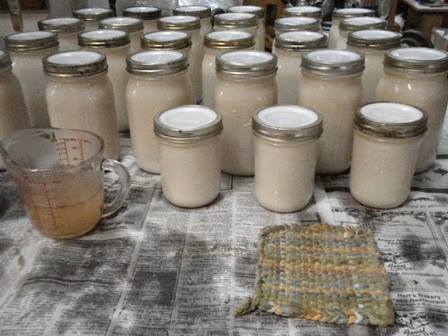
Then we remove the bones. Ken strains the stock , we let it cool, skim the fat and then I pressure can most of it for future use. This year I did two batches of 20 pints and have an additional gallon we are using now.
Once the meat comes back from the locker we render the lard. Animal fat was said to cause heart problems. Now we are reading that the real culprit is hydrogenated fat. Animal fat is only as good as how the animal was raised. An animal with access to the outdoors will have Vitamins A, D, E and K in the fat. Also consider that toxins ingested by animals are stored in the fat. It is imperative to obtain fat from animals exposed to as few toxins as possible - clean water and feed without pesticides.
We both like cooking with lard as a little goes a long way and it can take heat. I love olive oil for salad, but for cooking and baking, give me lard!
Subscribe to:
Posts (Atom)